- Rosary and The Way
- Journey the Mysteries
- Joyful Mysteries
- The Visitation of Mary and Elizabeth
The Visitation of Mary and Elizabeth
The Visitation of Mary and Elizabeth
Stand with me at Elizabeth's gate, where the Visitation of Mary and Elizabeth turns a secret too large to carry alone into a song two women sing together.
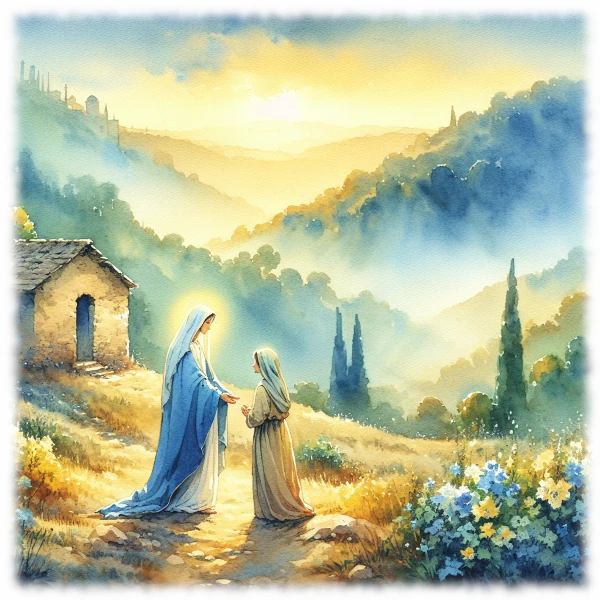
Praying this mystery as part of your daily Rosary? The Joyful Mysteries are prayed on Mondays and Saturdays — continue your journey, or step back to see the full path.
Before we reach the gate, let's pause on the road behind us. The Visitation of Mary and Elizabeth asks something of us before it gives us anything: who in your life has recognized something in you before you could name it yourself? Hold that question loosely as we arrive together.
The Visitation of Mary and Elizabeth
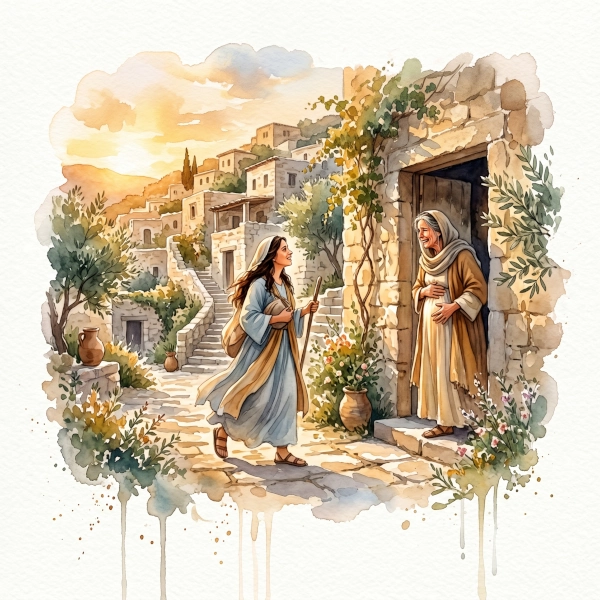
We arrive just as Mary reaches the gate of Elizabeth's courtyard. She has been walking for three days through the hill country of Judea, tired in the way anyone is tired after three days of hard walking — and more tired still in a way that has nothing to do with the road. She calls out from the gate. Elizabeth hears her voice and the child within her leaps. Not stirs. Leaps. The Holy Spirit fills Elizabeth so fully that she cries out before Mary speaks another word: "Blessed are you among women, and blessed is the fruit of your womb. And why is this granted to me, that the mother of my Lord should come to me?"
Mary has been carrying this secret since Nazareth, telling no one. And now someone else knows — is certain, is not frightened, does not need it explained. The relief that moves across her face is the relief of someone who has finally been able to set down something very heavy in the presence of a person who understands its weight. Then her voice rises, from somewhere older in her, the same place the Psalms come from. She begins to sing.
The Magnificat — Luke 1:46–55
My soul proclaims the greatness of the Lord,
my spirit rejoices in God my Savior;
for he has looked with favor on his lowly servant.
From this day all generations will call me blessed.
The Almighty has done great things for me,
and holy is his Name.
He has mercy on those who fear him
in every generation.
He has shown the strength of his arm,
he has scattered the proud in their conceit.
He has cast down the mighty from their thrones,
and has lifted up the lowly.
He has filled the hungry with good things,
and the rich he has sent away empty.
He has come to the help of his servant Israel
for he has remembered his promise of mercy,
the promise he made to our fathers,
to Abraham and his children forever.
— Sung by Mary in Elizabeth's courtyard, Ein Karem
She does not sing it for us. She sings it because it is true, and truth, when it finally has room to breathe, wants to become music.
A Question to Carry With You
Elizabeth recognized something in Mary before Mary spoke a word. Who in your life has been that kind of witness for you?
What Charity Actually Looks Like
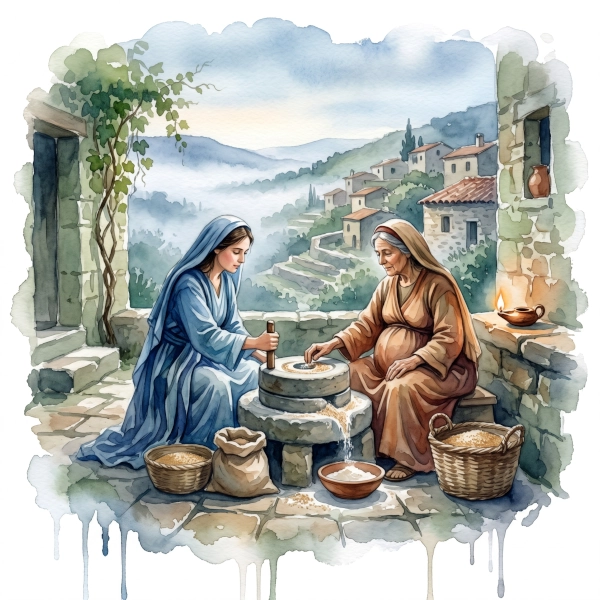
Luke tells us that Mary stayed about three months and then went home. That one sentence contains a great deal. Three months is not a visit — it is ninety days of another person's life lived alongside your own. Mary is in the early months of her own pregnancy, newly carrying one of the most extraordinary secrets a human being has ever been asked to carry, and she spends these months not in Nazareth preparing her own home, but doing someone else's tasks, making herself useful to someone whose need is greater than her own comfort.
This is what the Church calls charity — not the softened word we use today, a donation made at arm's length, a message sent to say we're thinking of someone. The original meaning. Love made concrete. Love that costs something real. Water drawn before the heat of the day. Grain ground, bread baked. Elizabeth in the final months of her own pregnancy, finding some tasks increasingly difficult. Mary taking them on without being asked, without keeping a running account of what she contributed. She simply did what needed doing and let that be enough.
And then there was Zechariah, moving quietly through the house in a silence that was not ordinary silence — he had doubted the angel in the Temple and lost his voice, and now this man whose whole vocation was built on words communicates by writing on a tablet. Living alongside him would have been its own formation in patience and attentiveness.
Something to Sit With
We live in a time when giving has been made very easy — money sent in seconds, good intentions expressed at almost no cost. And yet the one thing that cannot be sent by wire is the thing most people, in their hardest moments, actually need most: someone present with them in the room. When did you last give that? When did someone last give it to you?
John Is Born, Mary Returns Home

We are here when Elizabeth's time finally comes. The first cry of a new voice arrives, announcing itself with the confidence of someone who has a great deal to say. On the eighth day, the child is to be named. The neighbors assume Zechariah, after his father. Elizabeth says no — John. They look to Zechariah, expecting him to overrule her. He calls for the writing tablet: His name is John. At that moment his mouth opens and his tongue is freed, and the first words he has spoken in nine months pour out as a canticle.
Zechariah, His First Words — Luke 1:68–79
"Blessed be the Lord, the God of Israel; he has come to his people and set them free. He has raised up for us a mighty savior, born of the house of his servant David. And you, little child, you shall be called Prophet of the Most High, for you will go before the Lord to prepare the way for him."
Two songs bookend this mystery. Mary's Magnificat at the beginning, sung by a young woman who has just arrived carrying a secret she cannot yet share. Zechariah's Benedictus at the end, sung by an old man restored to speech by the fulfillment of the promise he doubted. Together they are the sound of what happens when God keeps his word to people who waited longer than they thought they could.
After three months, it is time for Mary to go home. The morning sun spills gold over the Judean hills as she wraps her arms around Elizabeth one last time — Zechariah loading a donkey with bread, dates, and a waterskin, his silent lips forming a blessing. The road north is the same road she walked south, but she walks it differently now, three months further along, the child stirring as she turns toward Nazareth.
At the Jordan, she pauses to cross — the same river, the same crossing, asking the same question of her it always asks of anyone: do you trust what's on the other side? She does. And when Nazareth finally comes into view, the white stone houses shining in the fading sunlight, three months feel both like a long time and no time at all. The baby grows inside her. Joy and nerves mingle in the air. What will Joseph think when he sees her again?
That question, too, is part of the mystery — the ordinary uncertainty woven through even the most extraordinary callings. Mary did not have every answer waiting for her at home. She simply walked toward it anyway, carrying what she had been given.
"Mary set out and went as quickly as she could to a town in the hill country of Judah." Luke 1:39
"She went into Zechariah's house and greeted Elizabeth." Luke 1:40
"Now as soon as Elizabeth heard Mary's greeting, the child leapt in her womb." Luke 1:41
"Elizabeth was filled with the Holy Spirit." Luke 1:41
"She gave a loud cry and said, 'Of all women you are the most blessed, and blessed is the fruit of your womb.'" Luke 1:42
"'Why should I be honored with a visit from the mother of my Lord?'" Luke 1:43
"'For the moment your greeting reached my ears, the child in my womb leapt for joy.'" Luke 1:44
"'Yes, blessed is she who believed that the promise made her by the Lord would be fulfilled.'" Luke 1:45
"And Mary said: 'My soul proclaims the greatness of the Lord and my spirit exults in God my savior.'" Luke 1:46–47
"Mary stayed with Elizabeth about three months and then went back home." Luke 1:56
With permission from The Scriptural Rosary, written by Joanne & John Bolger.
Published with permission from Christianica (America) Center.
Which of these verses resonates most with your prayer today? Let it sit with you a moment before moving on.
Mary's example of charity isn't just a lesson — it's a call. She didn't have all the answers when she arrived at Elizabeth's gate. She simply showed up, and stayed, for three months of ordinary, unglamorous help. Find one way today to show up for someone the way she did: not with a message sent in seconds, but with real presence.
Like Mary, you don't need to have the answers. You just need to show up. Here are two places to bring that charity into your own days, in ways both large and small.
Go Deeper · Path 4 Continue Praying · Path 1 Return to the Rosary Guide →Continue the Joyful Mysteries
Next: The Nativity of Jesus →