- Rosary and The Way
- Journey the Mysteries
- Joyful Mysteries
- The Annunciation of Mary
The Annunciation of Mary
The Annunciation of Mary
Walk with me to a small door in Nazareth, where the Annunciation of Mary begins a hundred-mile journey that starts with one trembling, faithful word.
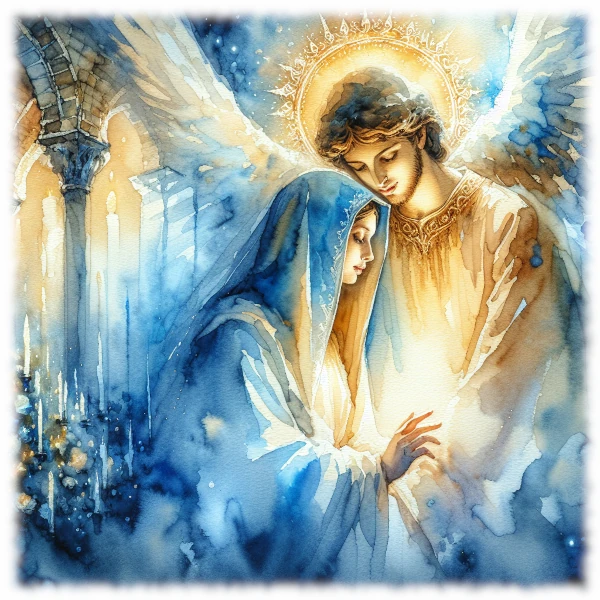
Praying this mystery as part of your daily Rosary? The Joyful Mysteries are prayed on Mondays and Saturdays — continue your journey, or step back to see the full path.
Before we knock at the door, let's pause on the threshold. The Annunciation of Mary asks something of us before it gives us anything: have you ever said yes to something before you understood what it would cost? Hold that question loosely as we step inside together.
The Annunciation of Mary
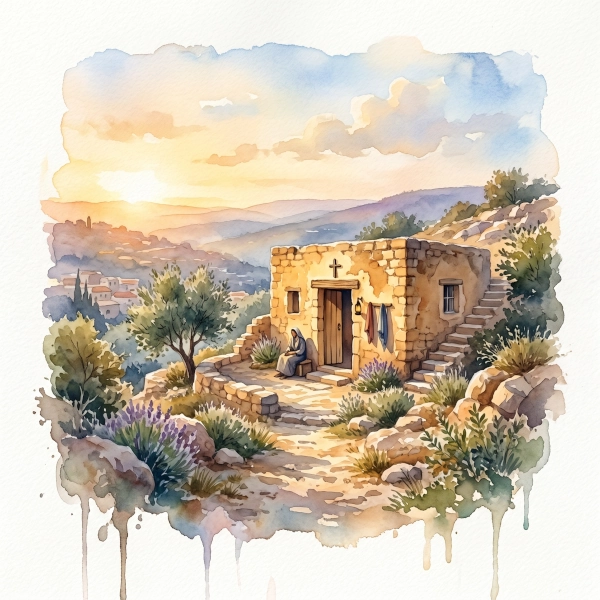
We arrive at the door of a small home in Nazareth as the last light of afternoon settles over the hillside. Something stops us at the threshold — a stillness that doesn't feel ordinary, the way a room feels after something immense has just passed through it. Mary stands near the window, her wool set down, her hands open at her sides. She is simply present — more present than anyone we have ever seen. Her face holds something we cannot name. A person who has just said yes to God and now carries the full weight of that word.
"I am the Lord's servant.
May your word to me be fulfilled."
— The yes that changed everything. Luke 1:38
She turns toward us — not startled, as though she knew we were coming. There is a new steadiness in her eyes, and beneath it, something trembling, like a flame just lit in wind. She is going to see her cousin Elizabeth in the hill country of Judea, nearly a hundred miles south. Today. Now. And somehow, we understand we are going with her.
She has told no one what happened in this room — not Joseph, not her mother. She carries it the way one carries a small light cupped in both hands, careful not to lose a single flicker. As we fall into step beside her through the streets of Nazareth, a question surfaces in us we barely know how to form: how does a person say yes to something so completely beyond their understanding? We do not ask her. We simply walk. And in the walking, she begins — quietly, almost to herself — to tell us what she remembers.
Mary, Remembering
"He told me not to be afraid. That is the first thing he said. Do not be afraid. And I thought — how can I not be? But the fear and the wonder were so tangled together I could not find where one ended and the other began."
"He said I had found favor with God. I, who had done nothing worthy of such a word. I am just — I am only —" She pauses, and her breath catches. "He said nothing is impossible with God. And I felt it as true, all the way through. So I said yes."
The Road South

Mary does not linger in Nazareth. She sets out southward through the Jezreel Valley, down toward the Jordan, then up into the hill country of Judea — nearly a hundred miles on foot. She does not explain her urgency. We simply feel it in her pace. This is the invitation of this pilgrimage: not to study the journey from a distance, but to walk it alongside her, noticing what rises in you — your own fears, your own held-back yes — as you move through the landscape she moved through, carrying the most sacred secret the world had ever known.
The road out of Nazareth is familiar to Mary, but today she moves through it differently — as someone carrying something invisible and immense. Mary is quiet. But her quiet is not empty. It is full, the way prayer is full even when no words are spoken.
✦ A Pilgrim's Memory — From the Road
Not too long ago I made a pilgrimage to Portugal, Spain, and France, to sacred sites where Mary had appeared. We landed after a long transatlantic flight expecting rest. Instead our group was bussed straight into an old city and started walking immediately — up cobblestone streets, tired legs carrying bags heavier than they needed to be. Around me I could hear the complaints rising — the jet lag, the aching shoulders. Then my sister leaned over and said quietly:
"This backpack is my cross."
Something shifted in me instantly. God hadn't taken us out of our comfort zone by accident. The discomfort wasn't an obstacle to the pilgrimage. It was the beginning of it. The cobblestones weren't in the way — they were the way.
By the time the Jordan comes into view, the landscape has changed completely. We stop at the bank without planning to. Mary stands at the edge and looks across, remembering something — not with sadness, but with recognition. This river is a crossing. Every crossing asks something of you.
The climb into the hill country begins gradually, then insists. The air cools and thins. Mary does not slow. She is not conquering the hill — she is simply in it, moving through it the way someone moves through difficulty when they have already surrendered the outcome to God. The silence up here is different from the silence in Nazareth. This silence is wide. It asks questions.
Ein Karem
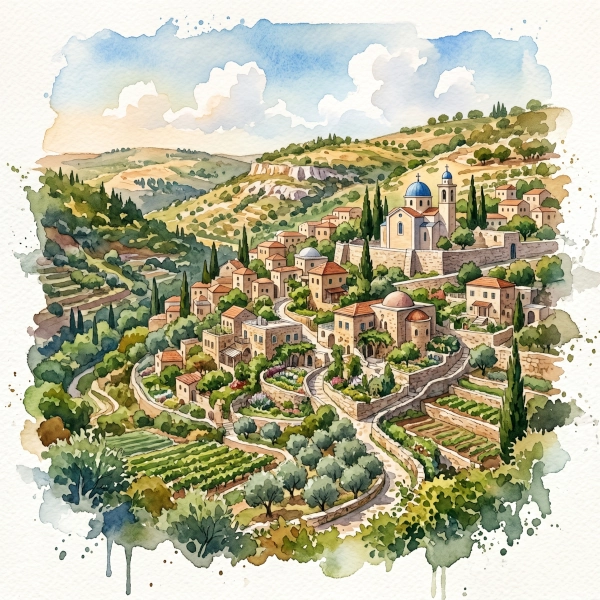
Then — over a final rise — Ein Karem appears below us, folded into the hillside like something placed there with great care. We feel Mary's pace change. She has carried this secret for days now, through valley and river and mountain, and ahead of her is the one person on earth who already knows. Elizabeth, who is herself carrying a miracle. The thought of seeing her moves visibly through Mary's body. She breathes differently. She almost runs.
We slow, instinctively. This moment is not ours to enter. We watch from just behind as she approaches the house, as she calls out, as the door opens — and we feel the joy of it from a reverent distance. That is enough. We have witnessed what remains after God has spoken to someone and they have said yes: not the angel, not the light, but a steadiness that does not come from the person alone. That steadiness is available to us too. In the ordinary rooms of our ordinary lives, the same God who spoke to her speaks still: do not be afraid. You have found favor. Nothing is impossible.
"The angel Gabriel was sent by God to a virgin; and the virgin's name was Mary." Luke 1:26–27
"Rejoice, so highly favored! The Lord is with you." Luke 1:28
"She was deeply disturbed by these words and asked herself what this greeting could mean." Luke 1:29
"But the angel said to her, 'Mary, do not be afraid; you have won God's favor.'" Luke 1:30
"Listen! You are to conceive and bear a son, and you must name him Jesus." Luke 1:31
"He will be great and will be called Son of the Most High; and his reign will have no end." Luke 1:32–33
"Mary said to the angel, 'But how can this come about, since I am a virgin?'" Luke 1:34
"The Holy Spirit will come upon you and the power of the Most High will cover you with its shadow." Luke 1:35
"And so the child will be holy and will be called Son of God." Luke 1:35
"'I am the handmaid of the Lord,' said Mary. 'Let what you have said be done to me.'" Luke 1:38
With permission from The Scriptural Rosary, written by Joanne & John Bolger.
Published with permission from Christianica (America) Center.
Which of these verses resonates most with your prayer today? Let it sit with you a moment before moving on.
Mary's fiat was not spoken into certainty. She did not know what the yes would cost, where it would lead, or how long the road would be. She spoke it into the unknown — and the unknown received her. Find one way today to say yes the way she did: not because the path is clear, but because the One who calls you is faithful.
Mary's fiat is humility in its purest form — not thinking less of herself, but trusting completely and asking nothing in return. If her yes stirred something in you, that virtue can be carried into your own days, not just admired in hers.
Go Deeper · Path 4 Grow in the Virtue of Humility → Continue Praying · Path 1 Return to the Rosary Guide →Let what you have said be done to me."
The contemplative tradition has always understood Mary's fiat as a pattern available to every soul — not the angel, that was once, for one — but the interior movement that made the fiat possible: the stillness, the listening, the willingness to say yes before the full picture is clear.
If something in Mary's yes has stirred a question in you — something you have been circling, a door you have not yet opened — the contemplative path is a place to bring it.
Continue the Joyful Mysteries
Next: The Visitation of Mary and Elizabeth →