The Eucharist
The Eucharist
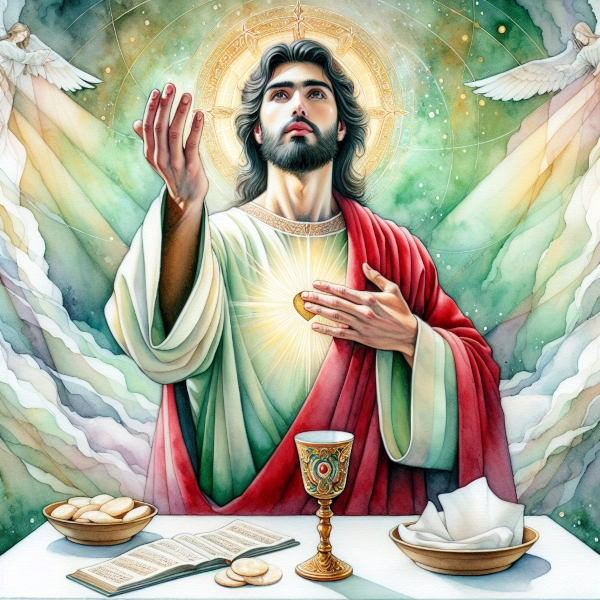
Come sit with me at the table of the Last Supper, where Jesus institutes the Eucharist, taking ordinary bread and wine and giving us something that has fed His Church for two thousand years. This mystery doesn't end at the altar — it carries forward into every Mass we attend.
Praying this mystery as part of your daily Rosary? Continue your journey through Thursday's beads, or step back to see the full path.
Let's take our place at the table. The Eucharist begins here, in an upper room in Jerusalem, on the night before everything changes — Jesus gathered with the Twelve for what will be called the Last Supper, though none of them yet know how much that meal is about to hold.
The Eucharist

We watch Jesus take the bread in His hands. He breaks it, the way bread has been broken at countless meals before this one, and then He says the words that will echo in every Mass from this night forward: "This is my body, which will be given up for you. Do this in memory of me." Then He takes the cup, and tells us it is His blood, the blood of the new covenant, poured out for the forgiveness of sins. The Eucharist is born in that ordinary room, at that ordinary table, through gestures any host might make — and somehow, through those same gestures, heaven and earth are bound together in a way that will never be undone.
For Catholics, the Eucharist is more than a symbol of that night. It is the heart of our faith — a sacred gift that carries the true presence of Jesus Christ forward into every tabernacle, every altar, every Communion line. Through the mystery of transubstantiation, the bread and wine become His Body and Blood. The outward appearance never changes; the essence does. It's not a memory we reenact. It's a living encounter, happening again, every time the words are spoken.
A Personal Reflection
For the longest time, transubstantiation was hard for me to fully accept. I would question how it was possible — how a priest, a man standing at an altar, could speak words that change the very substance of something. I don't have a tidy theological answer for that doubt. What I've come to trust instead is something closer to experience: I've seen how words spoken with love, or carelessly with harm, can shape a living thing — even something as simple as a plant responding to the words spoken over it. If something that small can be touched that deeply by words, I no longer find it so hard to believe that words spoken in persona Christi, at the altar, could do something immeasurably greater.
I try to carry that belief into how I receive the Eucharist itself. I practice a kind of deliberate awareness in that moment — slowing down, paying attention, letting myself feel honored rather than rushing through it as routine. Whether you're a lifelong Catholic or someone returning to the faith the way I once did, the invitation is the same: to come to the altar with your guard down, willing to be met.
But reverence doesn't only look like stepping forward. Sometimes it looks like staying in the pew. There have been moments in my own life when I felt the weight of something unresolved between myself and another person, and I knew, sitting there as the Communion line began to form, that my heart wasn't yet where it needed to be to receive. Choosing to remain seated in that moment wasn't shame — it was its own kind of honesty before God. If that idea is unfamiliar to you, or if you've ever wondered whether it's even allowed to sit one out, I've written more fully about a time I did exactly that, and what I learned from sitting still while everyone else walked forward.
"I am the living bread which has come down from heaven. Anyone who eats this bread will live for ever." John 6:51
"For my flesh is real food and my blood is real drink." John 6:55
"Whoever eats my flesh and drinks my blood lives in me and I live in him." John 6:56
After this, many of his disciples left him. Then Jesus said to the Twelve, "Do you want to go away too?" John 6:66,67
Peter answered, "Lord, to whom shall we go? You have the message of eternal life." John 6:68
"And we believe, and have come to know, that you are the Holy One of God." John 6:69
Now on the night he was betrayed, the Lord Jesus took some bread, and broke it. 1 Cor 11:23; Mt 26:26
And he gave it to the disciples, saying, "Take it and eat. This is my body." Matt 26:26
Then he took a cup and gave it to them. "Drink from this, all of you," he said. Matt 26:27
"For this is my blood, the blood of the new covenant, which is to be poured out for many for the forgiveness of sins." Matt 26:28
With permission from The Scriptural Rosary, written by Joanne & John Bolger.
Published with permission from Christianica (America) Center.
The Eucharist doesn't end when Mass does. The same presence we receive at the altar waits quietly in adoration chapels, inviting us to stay a while longer, with nowhere else we need to be.
Go Deeper · Path 6 Visit the Shrine of St. Joseph →Not receiving Communion as a Catholic may sound unusual to some. There have been moments when I knew my heart wasn't yet where it needed to be at the altar — and I learned that choosing to stay seated wasn't shame, but its own quiet act of faith. If you've ever wondered whether that's allowed, or felt that same heaviness yourself, I wrote honestly about one of those days.
Read: A Sacred Pause →From the Jordan River to this table, the Luminous Mysteries have walked with Jesus through the whole of His public ministry. Return to the hub to revisit any mystery, or continue your pilgrimage into the Glorious Mysteries.