- Rosary and The Way
- Journey the Mysteries
- Sorrowful Mysteries of the Rosary
- The Scourging At the Pillar
The Scourging at the Pillar
The Scourging at the Pillar
Stand with me in Pilate's courtyard, where the Scourging at the Pillar answers an honest question — "what is truth?" — with a body willing to bleed for it.
Praying this mystery as part of your daily Rosary? The Sorrowful Mysteries are prayed on Tuesdays and Fridays — continue your journey, or step back to see the full path.
Before we step into Pilate's courtyard, let's pause at the question he asks. The Scourging at the Pillar begins, strangely, with a question about truth — what is truth? Pilate asks it almost dismissively, but it's worth asking yourself honestly: when truth costs you something, do you still hold to it? Hold that question loosely as we walk in together.
The Scourging at the Pillar

As dawn broke over Jerusalem, the authorities delivered Jesus, bound, to Pontius Pilate, the Roman governor. Seated on his judgment seat, Pilate asked Him directly: "Are you the king of the Jews?" Jesus answered without flinching: "Mine is not a kingdom of this world; but yes, I am a king. I came into the world for this — to bear witness to the truth." Pilate's reply was almost a shrug: "Truth? What is that?" He found no case against Him, and still, to satisfy the crowd, ordered Him flogged.
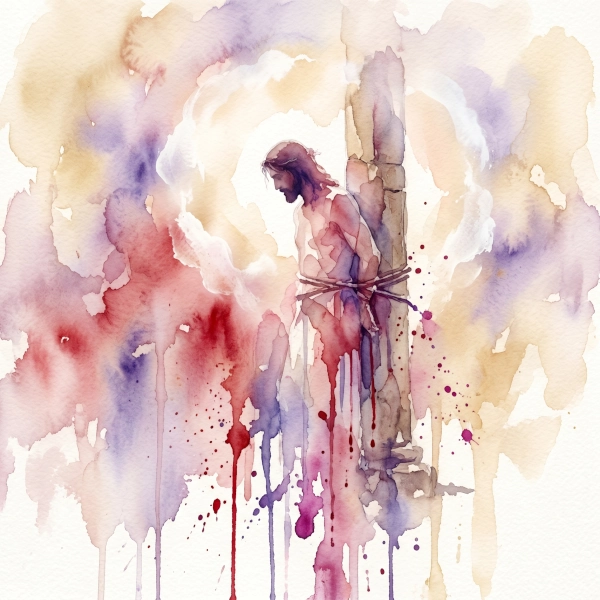
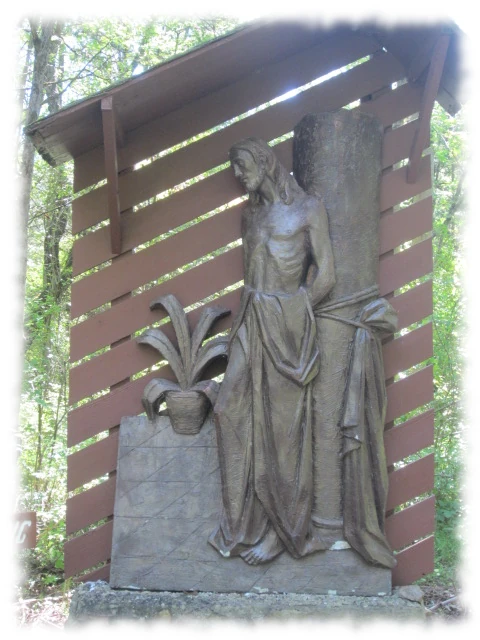
The soldiers led Jesus to the pillar and bound Him to it, the cold stone at His back. The first lash cracked through the courtyard like thunder. He did not cry out. Each strike landed the way the prophet Isaiah had described it centuries earlier — despised and rejected, a man of sorrows — and still He bore it with a silence that unsettled even the men inflicting it. They mocked Him as they worked, calling Him "King of the Jews" between blows, their cruelty and their laughter tangled together.
The Scourging at the Pillar isn't only a punishment Jesus endured — it's the moment private torture became public spectacle, a humiliation performed for an audience. When the soldiers finally grew tired, He hung limp against the pillar, His body a record of every lash. On him lies a punishment that brings us peace, and through his wounds we are healed. The greatest act of love in human history had not even begun yet, and already He had paid most of what it would cost.
Mary's Presence and Thoughts
Tradition holds that Mary was present for this, supported by her sister and a small group of grieving women, her heart aching with every lash her Son received. We imagine her groaning feebly, eyes red from weeping, stretching out her hands toward Him as He was led away — unable to stop what was happening, unwilling to look away from it either.
One detail from this devotion has always stayed with us: tradition says that after the scourging, Mary helped wipe up the blood of Jesus with linen sent by Claudia Procles — the wife of Pontius Pilate herself, the same Pilate who had just ordered the flogging. Claudia had reportedly had a troubling dream about Jesus and had urged her husband not to condemn Him. Whatever she could not stop with words, she offered in this small, quiet act of devotion instead. It's a strange comfort, finding mercy showing up from the household of the very man responsible for the cruelty — a reminder that grace can surface in the most unexpected places, even from someone you'd never expect to care.
They had Jesus bound and handed him over to Pilate. Pilate questioned him, "Are you the king of the Jews?" Mark 15:1, 2
Jesus replied, "Mine is not a kingdom of this world; but yes, I am a king." John 18:36, 37
"I came into the world for this; to bear witness to the truth; and all who are on the side of truth listen to my voice." John 18:37
"Truth?" said Pilate, "What is that?" And with that he went out again to the Jews and said, "I find no case against him." John 18:38
"So I shall have him flogged and then let him go." Pilate then had Jesus taken away and scourged. Luke 23:16; John 19:1
Despised and rejected by men, a man of sorrows. Isaiah 53:3
Harshly dealt with, he bore it humbly, like a lamb that is led to the slaughterhouse. Isaiah 53:7
Yet he was pierced through for our faults, crushed for our sins. Isaiah 53:5
Ours were the sufferings he bore, ours the sorrows he carried. Isaiah 53:4
On him lies a punishment that brings us peace, and through his wounds we are healed. Isaiah 53:5
With permission from The Scriptural Rosary, written by Joanne & John Bolger.
Published with permission from Christianica (America) Center.
Which of these verses resonates most with your prayer today? Let it sit with you a moment before moving on.
Pilate's question still hangs in the air centuries later: what is truth? Jesus answered it not with an argument but with His own bound and bleeding body — a willingness to suffer for what He knew was real, even when it cost Him everything. Find one way today to hold to something true even when it's inconvenient or unpopular. The Scourging at the Pillar reminds us that truth has always had a price, and that love is usually the one who pays it.
The brutal scourging weakens Jesus's body to the breaking point. When He later takes up the cross, this physical trauma causes His first fall — the private torture at the pillar becomes the public stumbling on the road to Calvary.
Go Deeper · Path 2