- Rosary and The Way
- The Way
- Via Crucis Stations
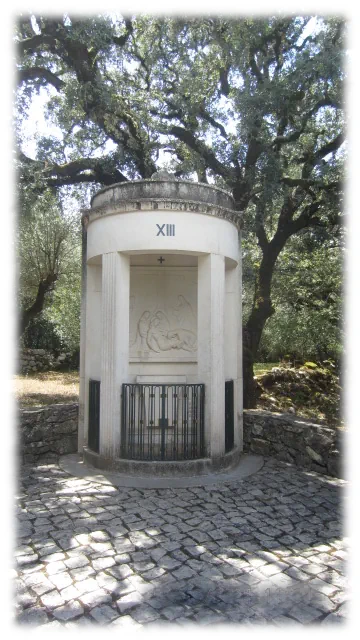
- Station 13
Via Crucis Station 13
Valinhos Sanctuary
The Sacred Way of the Cross
Via Crucis Station 13
JESUS IS TAKEN DOWN FROM THE CROSS
Via Crucis Station 13 presents what has become known as the Pietà—Mary receiving the lifeless body of her Son. Joseph of Arimathea and Nicodemus carefully remove the nails and gently lower Christ's broken body into His Mother's waiting arms. This station captures maternal grief that goes beyond any words I could ever find. Mary who held Him with joy in Bethlehem now holds Him in death. The body she nourished, protected, and loved beyond measure now lies broken, cold, utterly still in her lap. At Valinhos Sanctuary, this station honors Mary's complete participation in the work of redemption. She wasn't merely a witness; she was a co-sufferer. Her "yes" at the Annuncation reached its fulfillment here in her arms. She gave Him to the world at His birth; she receives Him back from the world at His death.
V. We adore Thee, O Christ, and we praise Thee.
R. Because by Thy holy cross, Thou hast redeemed the world.
Mother Mary, what was it like to hold Him again? Did you remember His birth, cradling the newborn King in this same embrace? Did you recall His first steps toward you, His childhood scrapes and bruises that you kissed and made better? Now you hold Him for the last time before the tomb, and there is no kiss that can heal these wounds, no mother's comfort that can wake Him from this sleep. Yet you don't despair into bitterness. You don't rage against God or curse heaven. You continue your "fiat"—let it be done according to Your will—even unto this unbearable hour of holding your dead child. Teach me your kind of faith, Mother. When I must let go of those I love, when death takes what is most precious to me, when loss seems utterly unbearable, give me your strength. Let me hold what I must release with both profound grief and supernatural trust, knowing that God ultimately holds us all.
Via Crucis Station 13:
Mary's Three Embraces
A mother's arms at birth, death, and beyond
Bethlehem's Embrace
Receiving New Life
Mary first held Him in Bethlehem's stable—tiny, vulnerable, completely dependent. She cradled the infant God, marveling at the miracle. That first embrace was full of wonder, joy, and fierce protective love. She could not have imagined then how she would hold Him again.
Calvary's Embrace
Receiving Death
Now she holds Him again—no longer tiny but broken, no longer warm but cold, no longer dependent but gone. The Pietà captures this second embrace: a mother receiving her dead Son. The same arms that first held Him in life now hold Him in death.
Heaven's Embrace
Reunion Beyond Death
Though we don't see it in the Gospels, tradition holds that Jesus appeared to His mother after the resurrection. Imagine that third embrace—Mary holding Him alive again, glorified, victorious. Death did not have the final word. Her sorrow has turned to joy. This third embrace is eternal.
Deepen Your Journey
Explore the richness of this station through sacred history, spiritual wisdom, and contemplative practices.
The Fátima Connection
Our Lady came to Fátima as Our Lady of Sorrows—the Mother who stood at the cross, who held her dead Son, who knows grief intimately and completely. She comes now to gather her children, to hold us as she held Jesus. The vision of the Immaculate Heart surrounded by piercing thorns reveals that Mary continues to suffer with and for her wayward children who reject her Son's love.
The thirteenth station invites me into the refuge of her maternal heart. Just as she received Jesus from the cross, she receives me from my crosses. Just as she didn't abandon Him in death, she doesn't abandon me in my darkest hours. Fátima is Mary's arms opened wide, calling: "Come to me, all you who are burdened."
Wisdom from Saints
According to St. Alphonsus Liguori, after Jesus, Mary is the most beautiful, most loving, and most powerful creature that exists. St. Bernard taught something that comforts me: in danger, in difficulty, in doubt, think of Mary and call on Mary.
St. John Paul II credited Mary with saving his life during the assassination attempt on May 13, the Fátima anniversary. According to St. Maximilian Kolbe, we should never be afraid of loving the Blessed Virgin too much, because we can never love her more than Jesus did. I'm learning to run to her arms when I need to be held in my grief.
Contemplative Practice
If I haven't yet consecrated myself to Jesus through Mary, I'm considering beginning the 33-day preparation using either St. Louis de Montfort's method or St. John Paul II's approach. I'm praying the Stabat Mater this week, standing spiritually with Mary at the cross, trying to feel what she felt, asking her to teach me how to suffer well.
I'm also doing a Letting Go Ritual: writing down something or someone I need to release into God's hands—maybe a relationship that's ended, a dream that's died, someone I love who has passed away. I fold the paper and place it before a statue of Mary, praying: "Mother, as you received Jesus from the cross, I give you this. Hold it in your Immaculate Heart for me."
Continue Your Prayer Journey with the Rosary
Your journey does not end here. Every step of prayer deepens your relationship with Christ crucified. Explore additional resources to cultivate grace and carry the peace of this sacred moment into daily life.
How to Pray the Rosary
Step-By Step Guide for Beginners →
Friday Rosary - Sorrowful Mysteries
Meditate on the Passion of Christ →
Sorrowful Mysteries
Begin a Virtual Pilgrimage →
Contemplative Meditation Prayer
Enter Deep Prayer and Silence with God →
The Virtue of Fervor in Prayer
Be Intentional in Our Prayer →