- Rosary and The Way
- Inner Journey
- Five Stones of Medjugorje
- The Stone of Prayer
The Stone of Prayer
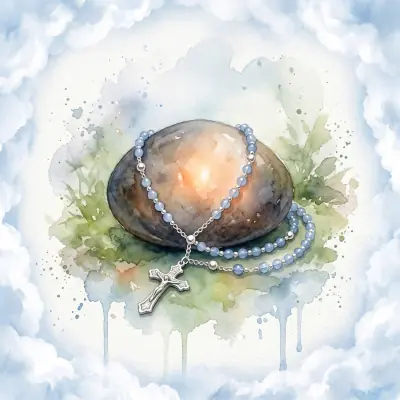
The Stone of Prayer
The Stone of Prayer reflects this morning's venture as we were trying to reach the Cathedral. We never got there. Something better happened instead.
Early that morning in Santiago de Compostela, most of our group had set out to walk the Camino. Another pilgrim and I chose differently—we just wanted to walk and talk, to share what God had been doing in our lives. We crossed the street from our hotel and began making our way toward the massive Cathedral we could see clearly in the distance.
But the ancient streets have their own logic. Left, then right, then left again—and somehow we were moving further away from where we were trying to go. We were lost. And then, in the way that only happens when your plans completely fall apart, I noticed something: an open gate, and beyond it, a spiral of stones laid out on the ground.
We walked into the garden. Each stone had words inscribed on it in different languages, most of which we couldn't read. But one stone—just one—was written in English. It bore the words of Seamus Heaney:
Inscribed in the Talking Stones Garden
"The dotted line my father's ashplant made
On Sandymount Strand
Is something else the tide won't wash away."
Footprints. A mark left behind, still there long after the tide goes out. I stood over that stone for a very long time. My steps were nothing new pilgrims had walked these exact paths for a thousand years. But the path was mine to make. And I hadn't found that stone by planning; I found it by getting lost.
That morning taught me something about the stone of prayer that no formal instruction ever had. I had been trying to get somewhere—the Cathedral, a clear, visible destination. And God had other plans. He led me away from where I was heading, into a spiral of stones I hadn't known existed, to a single line in my own language that said exactly what I needed to hear.
That is what prayer does, when we let it. It leads us away from our destination—and into the one we actually needed.
The Path of Repetition
This brings us to the stone of prayer, where our Lady in Medjugorje doesn't ask for perfect prayer. She asks for daily prayer. Not when the words come easily. Not when you feel completely ready. Daily—like bread, like breath. She asks especially for the Rosary.
For a long time, I found the rhythmic repetition of it strange. The same words, the same beads, the exact same order. Until I understood: the repetition isn't the final destination. It's just the path. What happens on the path is something else entirely.
"The souls still guard there. The eyes open for the miracle."
— Speaking Stones Reflection
When you pray the Rosary, you are never alone in it. Every person who has ever held these beads in a difficult moment—in a quiet hospital room, on a lonely hillside, or at a kitchen table at 3:00 AM—is somehow present in it right there with you. The communion of prayer is wider than we think.
"Line of the heart…"
— Speaking Stones Reflection
Three short words. What line runs through your heart right now? The stone of prayer is less about finding the perfect words and more about following that line—wherever it leads, even if you end up somewhere you hadn't planned.
The Rosary as a Mirror
The mysteries aren't just historical stories to remember. They are active questions to walk into.
The Joyful Mysteries & The Annunciation: I think of the Joyful Mysteries completely differently now. The Annunciation is the story of someone being asked to say yes to something entirely unplanned, something she could neither fully understand nor control. We often pray it as if it's strictly about Mary. But the spiral of stones keeps asking us: where in your own life is something being asked of you that you haven't said yes to yet? What Cathedral are you trying so hard to reach—when perhaps you're being led somewhere else entirely? Mary didn't ask for time. She asked one clarifying question, then she gave her fiat. What are you waiting to understand before you give yours?
The Glorious Mysteries: The fruit of persevering prayer. The Resurrection doesn't immediately explain itself. It appears quietly, inside a garden, to someone who had been weeping. Prayer rarely explains away our circumstances either. Sometimes, it simply changes what you see when you finally open your eyes.
The Agony in the Garden: Releasing the Cup
I have always been deeply drawn to the Agony in the Garden. Not because I fully understand it, but because I recognize it in my own life. Jesus asks for the cup to be taken away. And then, he lets it go.
I do the exact same thing in prayer—I arrive with what I think I need, what I am absolutely sure I want, and somewhere in the quiet, I remember that God already knows my heart better than I do. The asking isn't wrong. But the releasing—that's where the prayer actually happens.
Jesus was fully God, and still he had to choose to surrender. That doesn't make the process any easier for me; it makes it realer. If he needed that heavy moment at the stone in the garden, then I am allowed to need it too. I just have to borrow his strength to get there, because I don't have enough of my own.
The Prayer That Wasn't Answered the Way He Asked
He asked for the cup to pass. It didn't. He returned to the same prayer three times—the same petition, the same submission. If Jesus's prayer wasn't answered the way he asked, what does that say about the prayers in our lives that feel completely unheard?
The getting-lost might actually be the answer. The spiral of stones you didn't know was there—that might be where you were being beautifully led all along.
This is the mystery I return to when prayer feels hollow. Not because it hands me a neat answer—but because it shows me that the hollowness itself can be the prayer. He sweat blood in that garden and still whispered: "not my will, but yours." That isn't resignation. That's the deepest trust I've ever seen. And it looks, from the outside, exactly like being lost.
The Virtue That Grows: Receptivity
NOT PASSIVITY. NOT EMPTINESS.
It is the slow, hard-won ability to stop rushing toward the distant Cathedral you can see, and to notice the open gate immediately to your left. Prayer, practiced daily, builds this framework inside you over a lifetime. You don't notice it happening day by day. Then, one day, you simply realize: you are being led far more than you are leading. And you've finally stopped minding.
This Week's Seed
As you hold your own symbolic stone of prayer, take one decade of the Rosary while you pray it—a stone from your backyard garden, a pebble from a morning walk, anything solid, raw, and real.
Don't count the words.
Instead, count the silences between them.
When you finish, sit quietly for two minutes without saying anything at all. Notice what comes into that space. You don't have to understand it. You don't have to go where you planned. Just stay completely open to the gate you didn't expect.
Continuing the Pilgrimage
Once you have learned to step through that unexpected gate in quiet reflection, the path calls for a deeper, more intentional emptying of yourself. Walking with an open heart naturally leads us to open our hands and release the comforts we so easily hide behind.
When you are ready to explore how this quiet posture of receiving meets the physical discipline of letting go, continue forward to the Stone of Fasting, where we learn to carry our imperfect offerings up the hill and discover the true space that hunger creates.