- Rosary and The Way
- Inner Journey
- Five Stones of Medjugorje
- The Stone of Fasting
The Stone of Fasting
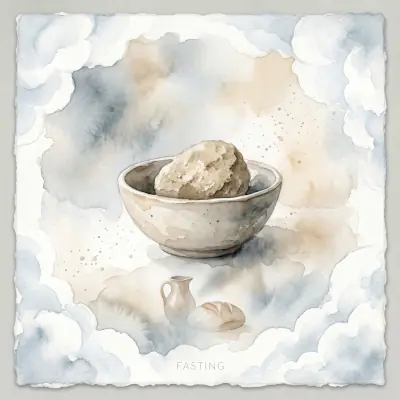
The Stone of Fasting
I am going to be honest with you, the stone of fasting is hard for me.
I have tried. I have wanted to. I have started, stopped, and started all over again. My schedule gets in the way. My hunger gets in the way. My deeply ingrained daily habits get in the way. And then, after a while, I stop talking about it and quietly set it down—always fully meaning to come back to it. I always mean to come back.
I am telling you this first because this page is not about achieving flawless success at fasting. None of us is perfectly holy. We know what we are called to, and yet we fall short. But that gap—the space between the high calling and our personal falling short—is not a reason to look away. It is exactly where something raw and real can happen.
The Practice: What Our Lady Asked
In Medjugorje, the message was remarkably simple: Wednesdays and Fridays. Bread and water. It was never intended as a rigid punishment, but rather as an invitation. It is a practical way of carving out an interior space inside yourself—a space that ordinary comfort quickly fills up and prevents us from ever noticing.
When the stomach is quiet, something else can finally speak.
That is the whole idea. It is not about raw willpower or human achievement. It is just about space—a little room made in the physical body so that something from outside the body can enter. Our Lady connected fasting directly to peace. Not personal peace alone, but world peace. The kind of peace that starts somewhere deep inside and radiates outward. Fasting, she said, could stop wars. That sounds extraordinary until you consider what wars are actually made of: the refusal to yield, the inability to let go, and the building of the self into something far too solid to be moved. Fasting loosens that grip. Even imperfectly. Even just a little.
Inscribed in the Talking Stones Garden
"The world is a bridge,
pass over it,
but build no houses upon it."
— Ibrahim
In the garden of speaking stones, this one stopped me in my tracks. It comes from a tradition completely different from my own, and yet—there it stands. It is the exact same truth the Church has always known: we are merely passing through. The temporary houses we build inside ourselves—out of physical comfort, routine habits, appetite, and rigid certainty—those are the very things the stone of fasting asks us to leave behind. Not forever. Just for a single day. Just long enough to remember that we don't actually live in them.
Two Stones on Cross Mountain
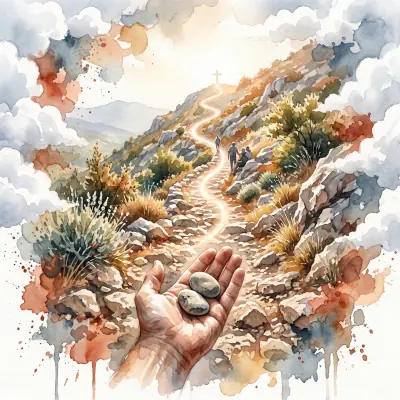
When I climbed Cross Mountain, I carried two small stones inside my backpack. I had distinct intentions for them—reasons I placed them in the bag early that morning. But I am unable to tell you what those exact reasons were. Time has washed away the words. What stays with me instead is the memory of the grueling climb. The intense heat of the day, the rough terrain of the path, and finally arriving at the base of the large white cross at the summit.
I placed the stones there and left them behind. I carried them up, and God knows why. That is enough. It has always been enough.
That, I think, is what fasting actually mirrors. You carry something real—the hunger, the inconvenience, the complete disruption of your ordinary day—up a hill you didn't technically have to climb. And then you leave it there. You don't need to be able to perfectly explain why. God already knows exactly what you meant by it. The intention doesn't have to be flawless, and neither does the execution. Just the carrying. Just the climb. Just the leaving it at the foot of the cross.
A Personal Reflection
Because of my work schedule, I have not yet fully committed to fasting the exact way Medjugorje asks. Wednesday and Friday on bread and water—I want that. I genuinely want to know what that kind of emptiness feels like from the inside, what it opens up, and what it makes room for. I am still actively working toward it.
I share this not to excuse it, but because I think you may recognize yourself in this exact struggle. We are not saints in perfect training; we are everyday people trying. And I truly believe that the desire itself—honest, sustained, and kept alive even when we fall short—is its own kind of fasting. Something deep within us keeps saying: this matters. I want to go deeper. That wanting is a prayer, and God receives it fully.
Where This Meets the Rosary
Once again, I return to the First Sorrowful Mystery: the Agony in the Garden. We see Jesus kneeling at a stone, asking for the cup to be taken from him. He was hungry for something entirely other than what was coming. And yet, he surrendered. Not because he didn't feel the immense weight of the cost—he felt it entirely—but because something in him trusted the larger plan more than his own comfort or survival.
That is fasting made total. It is not merely food set aside for a day; it is the self-set entirely aside. Everything.
When I struggle to maintain a fast—when I break it early, when I forget, or when I simply choose comfort—I intentionally bring my mind back to that garden. He knelt at a stone and let go of everything. I can try again this coming Wednesday. I can try again on Friday. The stone in that garden remains unmoved.
Our Lady of Medjugorje has asked for fasting on Wednesdays and Fridays—ideally on bread and water, though she has beautifully acknowledged that those with health concerns should do what they are practically able to do. The purpose is not physical discipline alone; it is a school of the human will. It is the practice of choosing, daily, what comes first.
This practice functions as one of the core pillars because it works directly alongside our initial stone of prayer. Where prayer opens the heart, fasting opens the hands. Together, they form a unified posture of total receptivity—the mark of someone who has emptied themselves enough that God can freely enter.
The Stations of the Cross walk this exact same road. Each station is a small, deliberate setting-down: of dignity, comfort, companionship, and eventually, life itself. Jesus does not cling. That is our ultimate model. That is what fasting—even our most imperfect fasting—keeps teaching us to practice.
You do not have to hurry through the entire Way of the Cross to find its fruit. Sometimes, the deepest fasting of the mind happens when you pull over on the road and spend time viewing just one single station, meditating deeply on that solitary moment.
To help you find that quiet focus, we offer six different shrine locations across this site, each presenting the stations through a completely unique visual and spiritual lens. You will find that every location offers something different to your heart. For instance, you can stand in the raw, unpolished simplicity of Garabandal Station 07, or shift your perspective to look at the towering, majestic heights of Lourdes High Station 07. They are the exact same moment in Christ’s passion, yet each whispers a completely distinct truth. Explore these different paths and notice which one meets your soul where it is today.
I still keep a smooth river stone resting on my desk, and another right near the door where I leave my keys each day. They serve as a physical anchor to remind me: stay grounded. Come back. The stone doesn't move, and God's patience never moves. I can always return to the practice—tomorrow, next Wednesday, next Friday, whenever I am ready to try again.
One stone at a time. One fast at a time. One small setting-down of what I thought I absolutely needed. One station at a time. That is enough. Keep going.
Stepping Into the Practice
- A Quiet Question to Carry: What is one thing—a physical meal, a mindless habit, a personal comfort—you could offer as an honest fast this week? Do it layout-style: not perfectly, just honestly. Carry it up the hill and leave it at the foot of the cross. God already knows what you meant by it.
- A Rosary Connection: Pray the First Sorrowful Mystery—the Agony in the Garden—and sit meditatively with Jesus kneeling at his stone. Notice what he completely set down. Notice what it cost him. Notice that he chose to do it anyway.
- From the Garden of Speaking Stones: Revisit the wisdom of "Build No Houses." Remind yourself of the stone that knows we are all merely passing through and challenges us to travel just a little lighter on our way to the next step: the Stone of Scripture.