- Rosary and The Way
- Inner Journey
- Contemplative Arts
- Speaking Stones
Speaking Stones
Speaking Stones
Speaking Stones leave words behind for whoever comes next.
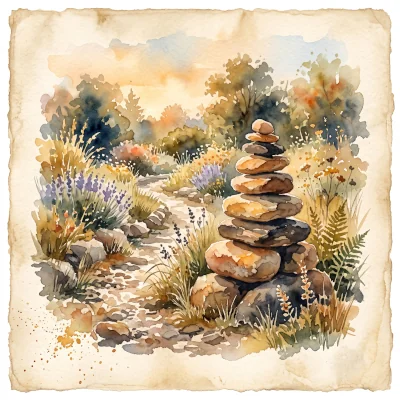
Speaking Stones is what this particular stone in the meditation gardens of Santiago de Compostela, Spain, seems to want to be. Inscribed with a short poem by the Galician poet Luz Pozo Garza, it gives the stone itself a voice — a vessel through which her words can still be heard by anyone who pauses long enough to read them.
At its heart, the poem sits life and death side by side, plainly, without flinching from either. And in its closing lines, the poet makes clear this isn't only a private meditation — she's leaving something behind for a wider "tribe," a word that reaches past any one person into a shared sense of kinship in the face of life's biggest questions.
Luz Pozo Garza — Author
Luz Pozo Garza was a respected Galician poet who spent much of her life writing and teaching. She passed away in 2020.

Words for the Tribe
This isn't merely a personal meditation — it reads more like a legacy meant to be shared with a larger community. In the context of Catholic spirituality, that sense of "tribe" can be understood as the universal Church — the global community of faithful followers of Christ.
By embracing this sense of community, the poem becomes a wellspring of comfort and inspiration. Its words can resonate across generations, cultures, and individual circumstances, reminding us that we are never truly alone in our spiritual journeys. We walk alongside a vast "tribe" of believers, united in our shared longing for the divine and our grappling with the universal themes of life and death.
The Power of the "Speaking Stone"
At the heart of this poem's contemplative power is the idea of the "speaking stone." By inscribing verses on a physical stone, the poet gives the work a sense of permanence and solidity — a vessel through which the words can be heard and contemplated by anyone who encounters it in the meditation garden's circle of stones.
This tactile, embodied quality encourages you to slow down, to feel the weight of the stone, and to truly listen to what it holds. It transforms the act of reading into something more physical — an invitation to deeper reflection on the poem's themes of life, death, and the human condition.

Reflections
How does this stone's exploration of life and death connect to the Mysteries of the Rosary and the Stations of the Cross?
What insights about the human experience might this stone offer to support your own spiritual growth?
In what way can reflecting on it alongside your Catholic practices help you feel a deeper sense of community and belonging?
Connecting the Stone to Spiritual Practices
This stone, carved into a "speaking stone" in the meditation gardens, can help deepen your faith as you explore the mysteries of the Rosary and the Stations of the Cross.
It touches on life and death — two of the most important themes in Catholic spirituality. When you pray the Rosary, you meditate on the joyful, sorrowful, and glorious moments of Jesus's life, moving through the full range of human experience, from birth to death, just as this stone does.
Similarly, the Stations of the Cross guide you through Jesus's journey to the crucifixion. This stone's contemplation of mortality can provide comfort and wisdom as you walk that sacred path with Christ. Luz Pozo Garza seems to want to share something of what she learned about the meaning of life and death — insights that can support your own spiritual journey.
As you read and ponder what's inscribed on the "speaking stone," you may feel a connection to the larger community of believers — the "tribe" the poet writes of. This sense of belonging can be very powerful when exploring life's biggest questions through Catholic practices.
Station II · Healing · You are here
Where would you like to go from here?
You do not have to decide all at once. These pages are nearby whenever you are ready. Stay as long as you need — and step forward only when you feel called.