- Rosary and The Way
- Pray the Rosary
- Our Lady of the Rosary Feast of October
Our Lady of the Rosary
A Feast on the anniversary of the battle.
A feast kept every October 7th — and the pattern hiding inside it that most of us never learned to see.
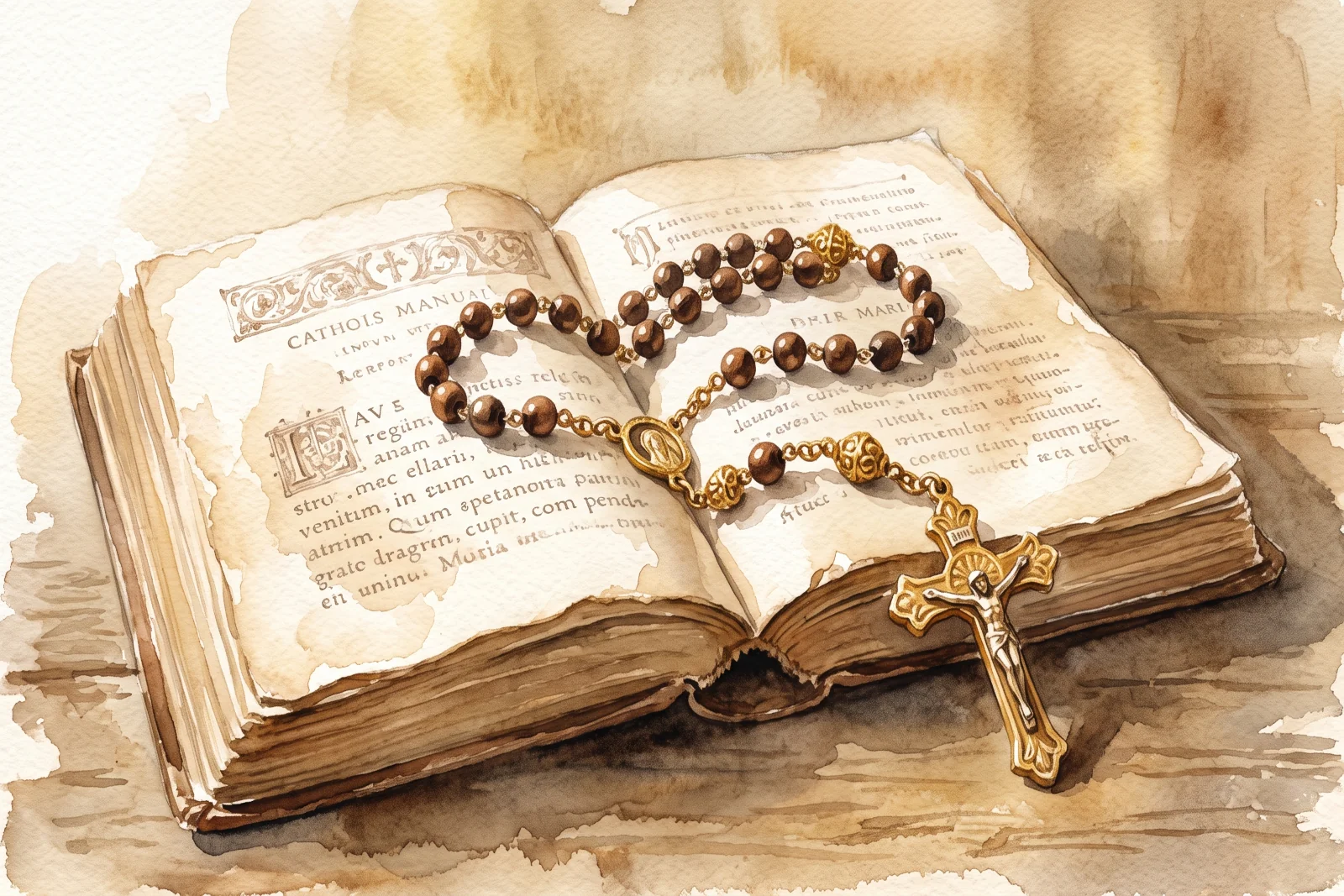
If you have just finished a 54-Day Rosary Novena, you already know the particular quiet that comes after it. Fifty-four days of the same beads, the same words, the same intention carried forward morning after morning — and then, on the fifty-fourth day, nothing marks the ending except your own decision to stop counting. No letter arrives to tell you whether it worked. No sign confirms the prayer was heard. You simply finish, the way you started: alone with it.
It is worth sitting with that honestly for a moment. Prayer, most of the time, asks us to act without evidence. You do not get to see whether the grace was given, or whether someone else's fifty-four days ran alongside yours, or whether any of it connected to anything larger than your own kitchen table or car seat or bedside. The not-knowing is part of what makes it prayer, and it is also, if we are honest, part of what makes it hard to trust.
But there is a day on the Church calendar — October 7th, the Feast of Our Lady of the Rosary — that exists precisely because, once in history, that uncertainty broke open into something visible. Ordinary people prayed the same prayer you just prayed, at the same time, for a reason nearly as urgent as any that ever brought you to your own beads — and the outcome was not only seen, but remembered every year since. Understanding how that feast came to be, and how it connects back to the Rosary and the Novena you already know, is the first small key to a much larger pattern most of us were never taught to notice.
A Pattern Most of Us Were Never Taught
Most of us know the big landmarks of the Church year without much effort. Christmas arrives with lights and family. Lent arrives with ashes on our foreheads and something we've given up. Easter arrives with an empty tomb and, if we're honest, a little relief that the fasting is over. These are the feasts that get talked about outside of church, so they stick.
What gets talked about far less is how a single, private, everyday act — one decade of the Rosary, prayed alone in a car or a kitchen — actually connects upward into all of that. I didn't see the connection clearly myself for a long time. It's easy to treat the Rosary as its own small island: something you do, on your own schedule, for your own reasons, disconnected from anything the wider Church is doing that day. The truth is quieter and, I think, more encouraging than that.
Here is the shape of it, the way I've come to understand it:
One decade, prayed today
54 days, gathered toward one intention
October 7th, fixed on the calendar
Everyone praying, together, across time
A single decade is real prayer, on its own, with or without anything else attached to it. But when many decades are gathered into a novena, and a novena is anchored to a fixed day the whole Church keeps every year, something happens that a private prayer alone can't quite show you: the sense that you were never really praying alone in the first place. Other people, in other kitchens and other cars, were carrying something forward on the same clock as you — even if you never meet them, even if you never find out how their fifty-four days ended either.
That's a comforting thought, but it's still just a thought until it's backed by something you can actually point to. October 7th happens to be the one day on this whole chain where the Church's memory holds something more than a thought — a moment where this exact pattern, prayer joined to prayer joined to a fixed day, produced an outcome that was seen, confirmed, and never forgotten.
The Day the Pattern Became Visible
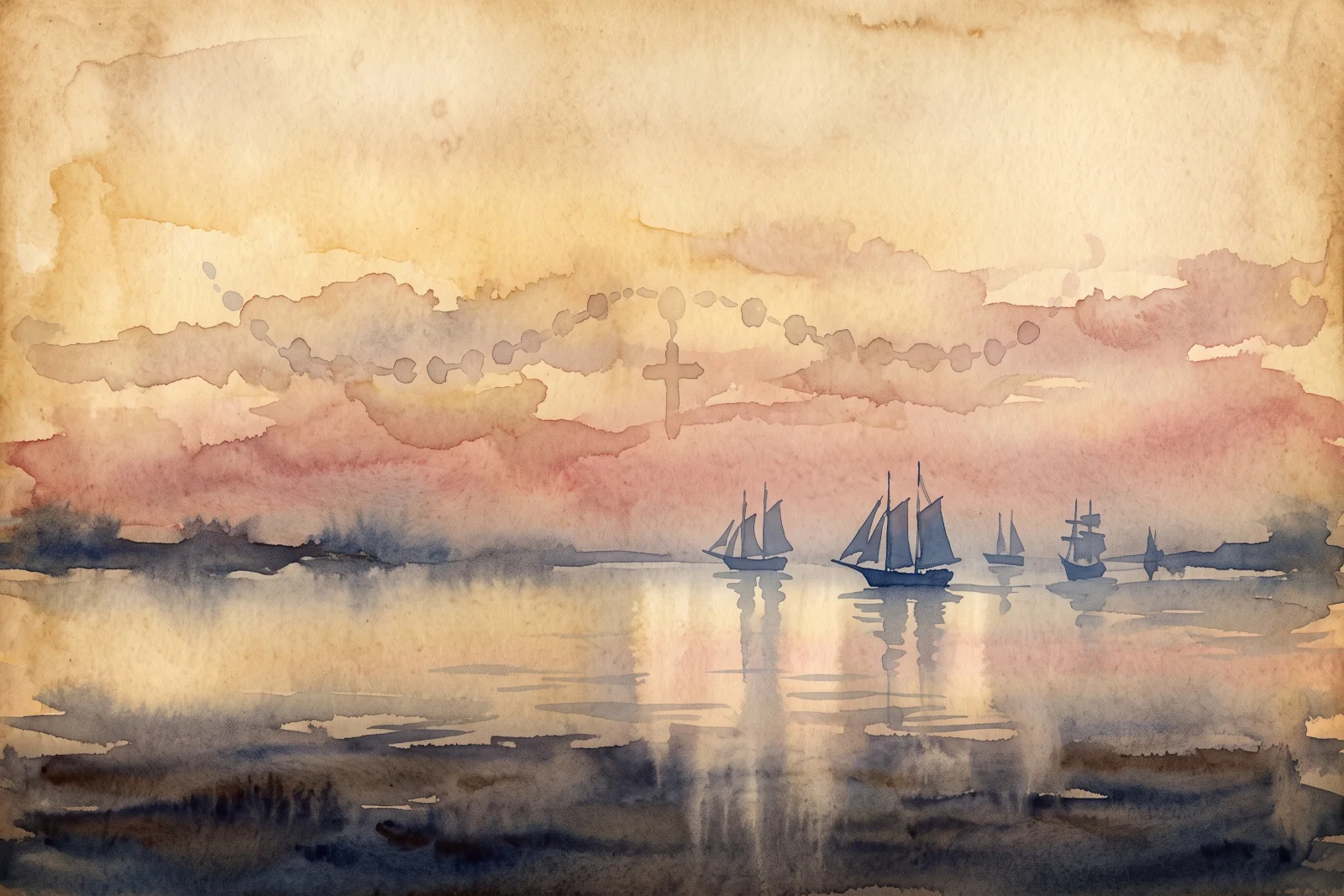
In the autumn of 1571, a massive fleet gathered in the Gulf of Patras, off the coast of Greece. On one side sailed the Ottoman navy, which had spent years expanding across the Mediterranean and had just taken Cyprus from Venice. On the other sailed the Holy League — ships pulled together from Spain, Venice, the Papal States, Genoa, and the Knights of Malta, united at the urging of Pope St. Pius V. For Christian Europe, the stakes felt total. A defeat here could open the door to Ottoman naval dominance across the entire Mediterranean.
Pius V did not just organize ships. In the days before the battle, he called on Catholics across Europe to pray the Rosary for victory — not privately and separately, but together, in confraternities and parish churches, all praying the same prayer toward the same end at the same time. It's worth pausing on how ordinary that instruction was. He didn't ask for a new devotion or a special miracle. He asked people to do the thing they already knew how to do — the same beads, the same words most of us learned as children — and to do it in step with everyone else.
On October 7, 1571, the two fleets met. What followed was one of the last great battles fought primarily with oar-driven galleys, and one of the most decisive naval victories in that era's history — the Holy League broke the Ottoman fleet in a single day, at a heavy cost of life on both sides. When word reached Rome, Pius V did not credit naval strategy alone. He attributed the victory to Our Lady's intercession, given through the Rosary that had just been prayed across the continent.
He instituted a feast on the anniversary of the battle — first called Our Lady of Victory. Pope Gregory XIII soon renamed it Our Lady of the Rosary, though the date itself moved for a time before Pope St. Pius X fixed it permanently to October 7th in 1913.
This is the one place in the whole chain where the pattern stops being a private hope and becomes a shared, remembered fact. Nobody who prayed alongside Pius V's call could have known, in the moment, whether their own decade mattered. They prayed anyway, joined to an urgency with no fixed day attached to it yet — and the Church has kept the outcome on its calendar for over four hundred years since. That's not proof that every novena ends the way you hope. It's proof that the not-knowing you sat with during your own fifty-four days has, at least once, resolved into something real and lasting for everyone to see.
This history is drawn from the Vatican's own record of the feast, published at vaticanstate.va.
Where This Might Lead You Next
Six honest questions, each pointing toward a different next step. Take whichever one actually meets you where you are today — not the one that sounds the most impressive to choose.
"If I'm honest, I never fully learned the Rosary the right way — I've just been muddling through."
Start with the beginner's guide →"I want to know what Our Lady actually promised the people who keep doing this faithfully."
Read the 15 Promises →"Victory isn't where I am right now. I need to sit with the sorrow for a while longer."
Pray the Seven Sorrows →"I didn't realize how much of the Church calendar I've never actually paid attention to."
See the Holy Days of Obligation →"Lepanto was Glorious-adjacent for me — I want to go deeper into one specific mystery."
Enter the Coronation of Mary →"I don't just want to read about this — I want to walk it somewhere real."
Walk the Medjugorje Garden →Whether your own fifty-four days ended in a clear answer or in silence, October 7th will come again this year, the same as it has every year since 1571 — and it will find you wherever you are in your own prayer, not where you think you should be.
The Rosary Doesn't Have to Be the Only Path You Walk Today
The Next Stop on This Road
October 7th isn't the end of the calendar's invitation to keep praying. As the Church year turns toward Advent, the same rhythm of daily, repeated prayer continues in a different key.