- Rosary and The Way
- Garabandal
Garabandal Spain Village
Path 6 — Pilgrim Adventures
The village in the mountains where Our Lady came — and where I learned to put things in God’s hands
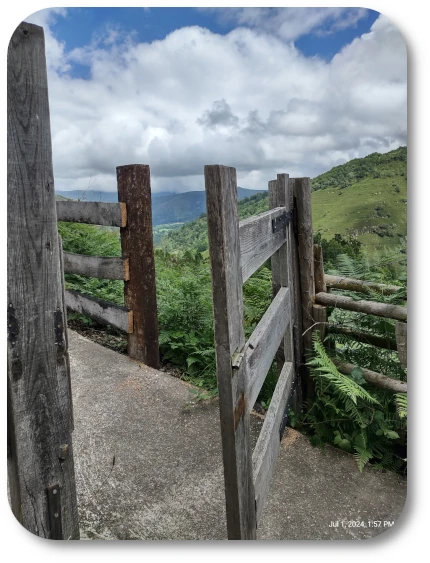
San Sebastian de Garabandal — a small village nestled in the foothills of the Cantabrian Mountains of northern Spain.
This pilgrimage was nothing like Medjugorje. Where Medjugorje was intimate — a small group, a few holy places, a rhythm of prayer and rest — this was a comprehensive journey across Portugal and Spain and France, organized by Penny, the same pilgrim leader who had guided me through Medjugorje. When Penny plans a pilgrimage, it is always meaningful. But this one moved.
Fatima, Santiago de Compostela and the Cathedral of St. James the Apostle. Santa Cueva Covadonga, Garabandal, The Monastery of Santo Toribio de Liebana, where a piece of the True Cross is kept and Loyola. And finally Lourdes. Each place sacred. Each place holding something different. On a 206 Tours pilgrimage there is no time to think — you breathe, you move with the group, you receive what each place gives you and keep walking.
Garabandal was one stop among many. But it is the one I want to tell you about.
Garabandal Spain Village
THE JOURNEY IN
Breathing and Moving
We arrived in Portugal first. Getting off the plane, jet lag already settling in, one in our group with a swollen ankle from the journey. We were carrying things with us from the flight because there would be no hotel until much later that day. I felt I was simply breathing and moving — present but not yet fully arrived. I noticed others feeling the same way. The tiredness was visible in the group.
That is something nobody tells you about a major pilgrimage circuit. The first day is an act of pure surrender. You give your body to the journey before your spirit has caught up. And somehow that is exactly right — it strips away the self-sufficiency before the sacred places even begin.
On a planned pilgrimage circuit there is no time to think. You breathe. You move with the group. You receive what each place gives you and keep walking. That is its own kind of prayer.
SAN SEBASTIAN DE GARABANDAL
The Poorest Village — and the Most Religious
Garabandal is a small village in the foothills of the Cantabrian Mountains of northern Spain, under four hundred residents living in stone-built dwellings. It was considered the poorest village in the region. It is also, by every account, the most religious.
One woman used to walk through the streets each evening ringing a bell to remind residents to pray for the dead. Now a church bell rings, summoning all to the Rosary.
The Village Bell
The bell that still calls this mountain village to prayer.
Something about that continuity — the same intention, a different instrument, century after century — felt like the whole village in a single image. A place so poor it had almost nothing, and yet it kept the one thing that mattered most.
The apparitions here occurred between 1961 and 1965. Four young girls — Conchita Gonzales, Mari Loli Mazon, Jacinta Gonzalez, and Mari Cruz Gonzalez, all between eleven and twelve years old — began seeing an angel and then Our Lady herself at a rocky lane in the village known as la Calleja.
It began, as so many sacred things do, with something ordinary. On June 18, 1961, the children had taken apples from a neighbor's tree and gone to la Calleja to eat them. A loud thunderous sound from the sky. Conchita's head thrown back, hands clenched to her chest. The others screaming, wanting to run — and then falling into the same ecstasy. They all saw the same vision of an angel who did not speak and then disappeared.
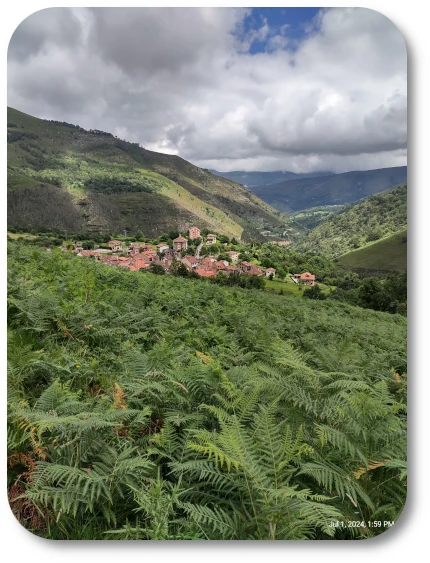
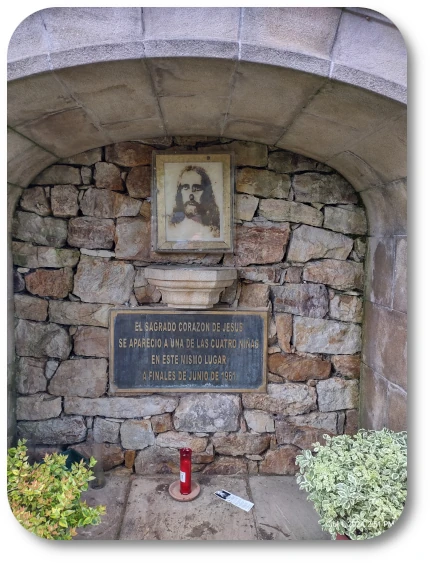
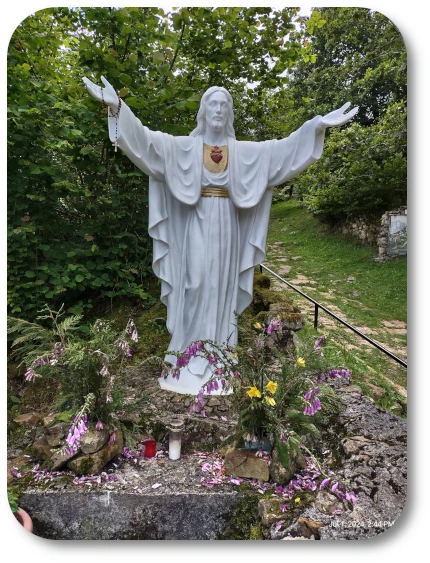
The lane known as la Calleja — where the four children sat with their apples on June 18, 1961.
WHAT OUR LADY SAID
The Messages of Garabandal
On July 1, 1961, the angel spoke for the first time: “Do you know why I have come? It is to announce to you that tomorrow the Blessed Virgin will appear to you as Our Lady of Mount Carmel.” The following day, feast of the Visitation, the girls fell to their knees with eyes fixed above.
What followed over the next four years was a series of apparitions and messages that are still held carefully by the faithful who visit this place. The messages carried five elements: a Warning, an illumination of conscience; a worldwide Miracle to follow within a year; a permanent Sign to be left at the apparition sites; and a Chastisement if humanity does not turn back to God. These apparitions have been neither approved nor condemned by the Church and remain under investigation.
The First Message — October 18, 1961
“We must make many sacrifices, perform much penance, and visit the Blessed Sacrament frequently. But first, we must lead good lives. If we do not, a chastisement will befall us. The cup is already filling up, and if we do not change, a very great chastisement will come upon us.”
Inside the Church
The Eye Above the Altar
The church in Garabandal is small — the way a village church should be. Filled with relics that I found deeply interesting. I spent time with each one, reading, praying, standing in the presence of what had been carried there from other holy lives.
While I was sitting quietly inside, I noticed an eye above the altar. The children had described an eye looking at them during their apparitions — a sense of God watching them through this eye. Sitting in that same space, looking up at it, I felt it too. Not frightening. Simply true. The feeling of being seen completely and not found wanting for it.
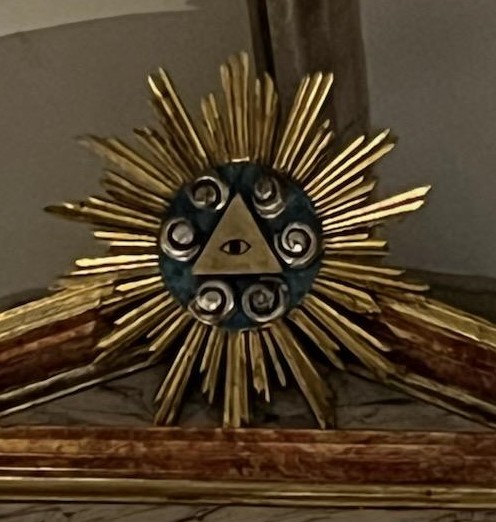
The eye above the altar. The children described this same sensation — of God watching them through it. Sitting there, I understood.
Relics
Among the relics in the church were those of Saint Theresa of Calcutta and Saint Padre Pio — two saints whose lives were defined by suffering offered willingly, by presence to the poorest and most forgotten. In a village that was itself considered the poorest in the region, their presence felt fitting.
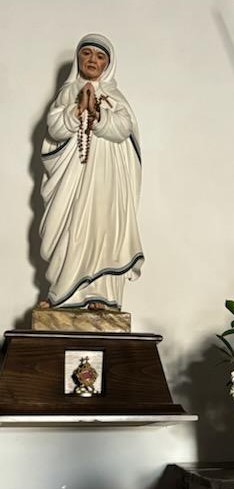
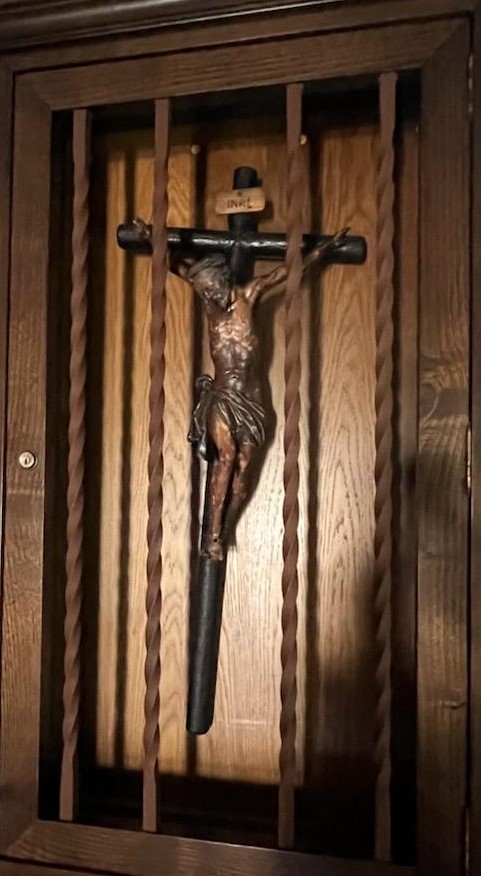
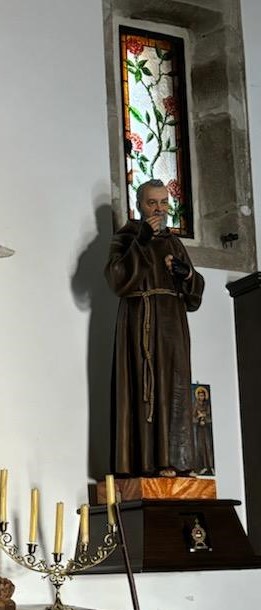
Saint Theresa of Calcutta — a relic of the cross — Saint Padre Pio.
WORDS THAT HIT HOME
At the Pilgrim Center
During the presentation at the pilgrim center, two things in particular stayed with me. Not as distant spiritual maxims but as something that landed personally — words that found the places in me that needed finding.
— Our Lady to Conchita
“You should visit my Son in the tabernacle more often. Why do you let yourself be carried away by slothfulness so as not to visit Him? He waits for you day and night.”
— Our Lady to Conchita
“Remember what I told you on your saint’s day: when presenting yourself before God, your hands must be filled with good deeds done for your brothers and for His glory. At the present time, your hands are empty.”
Those two statements are not comfortable. They are not the kind of spiritual encouragement that leaves you feeling warmly affirmed. They are the kind that ask you to look honestly at how you are spending your days and what you are bringing to God with your hands. I left the pilgrim center quieter than I entered.
Continue the Journey
Garabandal Was One Stop
The pilgrimage continued from here to Lourdes. And the lessons that began in this quiet mountain village kept unfolding long after I came home.
Next Stop
Lourdes
Where the sick come not only for healing of the body but for the grace to surrender everything to Our Lady. The last stop on this pilgrimage circuit — and a place that holds its own story.
Lourdes →Path 4 — Grow in Virtue
Patience and Surrender
What Garabandal asked of me — in the climb, in the silence, in what I could not resolve — connects to the virtues the mysteries teach. If the mountain stirred something in you, this path goes deeper.
Grow in Virtue →Path 6
All Pilgrimages
Garabandal was one place on a longer road. Return to the pilgrimage hub to explore Medjugorje, Lourdes, and the other sacred places on this path.
All Pilgrimages →You might like these
Cross Mountain | Climbing Mt. Krizevac at Dawn in Medjugorje
Cross Mountain — Mt. Krizevac before dawn, boulders underfoot, the Stations of the Cross prayed aloud. A climb that was ridiculous and grace-filled.
Pilgrimage | How a Friend's Journey Planted a Seed of Faith
Pilgrimage — A friend went to Medjugorje first. No signal, no towers, no internet — and a text arrived every six hours anyway. That is where my story begins.
Medjugorje | A Pilgrim's First Journey to Bosnia Herzegovina
Medjugorje — it was meant to be Germany. A pandemic redirected everything. And as I would learn about how God works — the redirection was the point.


